Wasp Nest Removal: DIY vs Professional — When It’s Too Dangerous
You’re standing in your backyard with a can of wasp spray, staring at a nest the size of a basketball hanging from your garage soffit. You’ve watched three YouTube videos. You’ve got protective gear. You’re thinking: “I can do this myself.”
Here’s the truth most DIY guides won’t tell you: wasp nest removal sends over 500,000 North Americans to the emergency room every year, and the vast majority of those trips happen because someone tried to remove a nest themselves without understanding what they were dealing with.
Some nests are safe to handle yourself. Most aren’t. This guide will tell you exactly when DIY is reasonable and when calling a professional isn’t just smart — it’s the only safe option.
The Species Question: Not All Wasps Are Equal
Before you do anything, you need to know what you’re dealing with. Ontario has three main problem wasps, and they behave very differently.
Paper Wasps (Polistes)
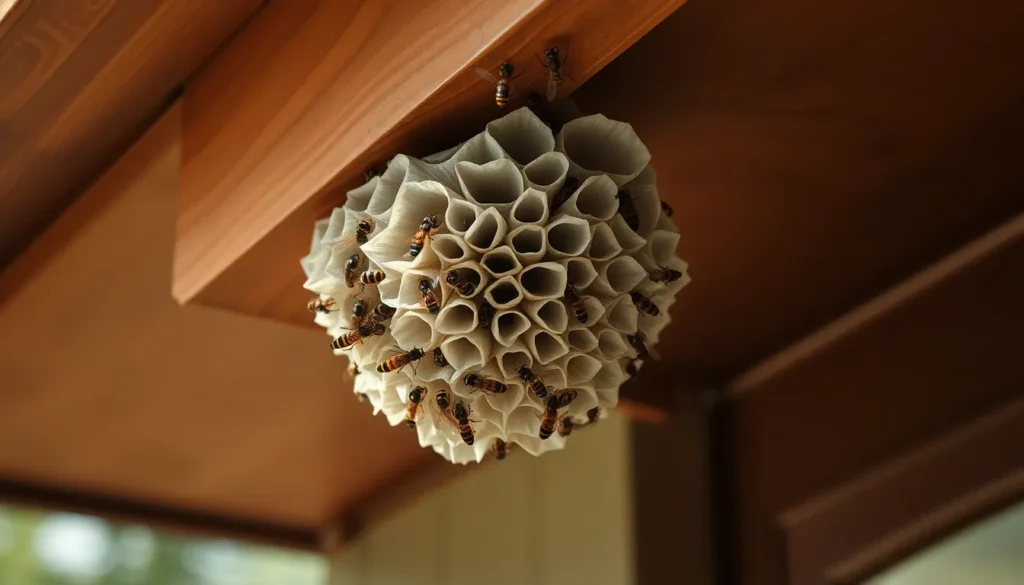
These build the classic umbrella-shaped nests you see hanging from eaves and deck railings. They’re brownish-red with long legs. Paper wasp colonies are small — usually 20-75 wasps per nest. They’re the least aggressive of the three and the most DIY-friendly if caught early.
DIY-able? Sometimes. If the nest is smaller than a golf ball and easily accessible, paper wasps are manageable. But they’ll still sting if provoked.
Yellow Jackets (Vespula)
Yellow jackets are the wasps most people hate. They’re the ones dive-bombing your soda cans at picnics. They build enclosed nests, often underground in old rodent burrows or inside wall voids. By late summer, a single yellow jacket nest can house 5,000+ wasps.
DIY-able? Almost never. Yellow jackets are extremely aggressive, especially near the nest. They can sting multiple times and will chase you. Underground nests are particularly dangerous because you often don’t see them until you step on one or run a lawnmower over the entrance.
Bald-Faced Hornets (Dolichovespula maculata)
Despite the name, these are actually wasps. They build large, enclosed paper nests in trees and shrubs — those grey, football-shaped nests you see 10-20 feet up. Colonies can reach 400-700 wasps by late summer, and bald-faced hornets are viciously defensive.
DIY-able? No. Don’t even think about it. These wasps will attack in swarms if you get within a few feet of the nest, and their sting is particularly painful.
When DIY Wasp Nest Removal Is (Relatively) Safe
If all of these conditions are true, DIY might be reasonable:
- The nest is small — golf ball size or smaller (early season, fewer than 25 wasps)
- You can reach it easily — no ladders, no climbing, no awkward positions
- It’s a paper wasp nest — not yellow jackets or hornets
- You’re not allergic — if you’ve ever had a serious reaction to a sting, don’t risk it
- You have an escape route — you can retreat quickly without tripping or falling
- It’s early morning or late evening — wasps are sluggish in cool temps (below 15°C)
If even one of these is false, call a professional.
The DIY Method (If You’re Proceeding Against Advice)
If you’ve decided to go ahead, here’s how to minimize risk:
Timing matters. Do this at dawn or dusk when wasps are least active. Never attempt nest removal in the middle of a hot July afternoon.
Gear up. Long sleeves, long pants, gloves, closed-toe shoes. A bee suit is ideal but overkill for a tiny nest. At minimum, tuck your pants into your socks and wear a hoodie. Wasps crawl under clothing.
Use the right spray. Get a wasp-specific spray with a 15-20 foot range (Raid Wasp & Hornet Killer is the standard). Stand as far back as possible. Spray directly into the nest entrance or onto the nest surface for 10-15 seconds. Then back away immediately.
Don’t knock it down yet. Wait 24 hours. Return the next evening and check for activity. If no wasps are flying, knock the nest down with a long stick or pole (still wearing protective gear). Bag it and throw it out. If wasps are still active, spray again and wait another day.
One chance only. If wasps start swarming during your first spray, run. Don’t try to finish. Don’t swat at them. Just run in a straight line for 50-100 feet and get indoors. Call a professional.
When You Absolutely Need a Professional
Some situations are never DIY-safe. Here’s when you call the pros:
1. Nests Inside Walls or Structures
If you hear buzzing inside your walls or see wasps entering a small crack or vent, the nest is inside your structure. These nests can be massive — we’ve pulled yellow jacket nests the size of a beach ball out of attic spaces. You can’t see the size, you can’t access it safely, and you can’t remove it without opening up walls. Spraying the entry hole just makes them angry and often drives them further into your house.
2. Underground Nests
Yellow jackets love old rodent burrows. You’ll see wasps flying in and out of a small hole in the ground. The nest itself is a foot or more below the surface and can house thousands of wasps. Pouring gasoline or boiling water into the hole (common “folk remedies”) is dangerous, ineffective, and in Ontario, pouring accelerants into the ground near your home is a fire code violation. Professionals use dust insecticides applied directly into the burrow entrance — these spread through the nest within hours.
3. Nests You Can’t Reach Safely
Any nest that requires a ladder, especially a tall ladder (10+ feet), is a professional job. If wasps attack while you’re on a ladder, you’re going to fall. Wasp-related falls cause more serious injuries than the stings themselves.
4. Large Nests (Softball-Sized or Bigger)
By mid-summer, many nests in the GTA are the size of a cantaloupe or bigger. A nest that size has hundreds to thousands of wasps. When disturbed, they don’t just sting the nearest threat — they swarm. Even pros approach these with full protective suits and often treat them at night when the entire colony is inside the nest.
5. Multiple Nests
If you’ve got more than one nest on your property, you’ve got a bigger problem. Either your yard is particularly attractive to wasps (food sources, sheltered areas, water access), or you’re dealing with an established nesting site that wasps return to annually. Professionals can assess why your property is attracting them and treat the area to prevent future nests.
6. You’re Allergic (or Someone in Your House Is)
If anyone in your household has a known wasp allergy, don’t attempt removal yourself. Anaphylaxis can occur within minutes. It’s not worth the risk.
What Professional Wasp Nest Removal Actually Involves
Here’s what happens when you call us for wasp nest removal service:
Same-day service in most cases. During peak season (July-September), we know wasp problems don’t wait. If you call before noon, we can usually be there the same day.
Species identification. We confirm what you’re dealing with. Sometimes what looks like a wasp nest is actually a harmless mud dauber nest (solitary wasps that don’t defend their nests). We won’t charge you to remove something that isn’t a threat.
Safety assessment. We evaluate nest size, location, and activity level. We’ll tell you if it’s a true emergency (e.g., yellow jackets entering your kid’s bedroom through a wall vent) or if it can be scheduled for the next morning when treatment is safest.
Full protective gear. Pros wear bee suits, gloves, and veiled helmets. We’re not tougher than DIYers — we just have the right equipment.
Treatment that works. For aerial nests (paper wasps, bald-faced hornets), we use direct spray application. For ground nests and wall voids, we use dust insecticides that the wasps carry back into the nest. Treatment usually results in total colony elimination within 24-48 hours.
Nest removal (when safe). If the nest is accessible, we remove it after treatment. For nests inside walls or underground, we seal entry points once activity has stopped.
Prevention advice. We’ll point out other vulnerable spots on your property (open soffits, gaps in siding, wood piles near the house) where wasps are likely to build next.
Wasp Nest Removal Costs in the GTA
Here’s what you can expect to pay for professional removal in 2026:
- Small, accessible nest (paper wasp, easy reach): $150-250
- Large aerial nest (bald-faced hornet, high up): $250-400
- Ground nest or wall void (yellow jackets): $200-400
- Multiple nests or recurring treatment: $400-600+
Compare that to an ER visit for multiple stings (average cost in Ontario: $500-1,000 after triage, treatment, and observation) or a fall from a ladder (potential thousands in medical costs, lost work, and liability if you’re injured on your own property and your homeowner’s insurance challenges the claim).
Why Wasp Problems Are Getting Worse in Ontario
If it seems like there are more wasps than there used to be, you’re not imagining it. Mild winters and longer warm seasons mean higher wasp survival rates. In Vaughan, Brampton, and newer GTA subdivisions, construction disturbs ground-nesting sites and forces yellow jackets to relocate to residential areas. We’ve seen a 40% increase in ground nest calls over the last three years in Vaughan and Brampton specifically.
Add to that: wasps are opportunistic. They eat other insects (good) but are also drawn to sugary drinks, open garbage bins, compost, and fruit trees. If your yard has any of these, you’re more attractive to wasps.
What NOT to Do
These are the methods that consistently send people to the hospital:
Don’t use fire. Lighting a nest on fire doesn’t kill the wasps — it angers them, and now they’re on fire and angry. Burning nests near your home is also a fast way to start a structure fire.
Don’t seal the entrance. If you plug the hole where wasps are entering (e.g., a vent or crack), they’ll find another way out — often into your living space. We get calls every summer from people who sealed a nest entrance and then found 200 wasps inside their kitchen.
Don’t knock it down first. Knocking down an active nest before treating it releases hundreds of wasps all at once. Treat first, remove later.
Don’t use a pressure washer. This seems logical — blast the nest off the house from a distance. In reality, it drenches the wasps but doesn’t kill them, and now you’ve got a soaking wet, furious swarm and you’re holding a loud machine that prevents you from hearing them coming.
Don’t ignore it. “Maybe they’ll leave on their own” is a common hope. They won’t. Wasp nests grow all season. A small nest in May becomes a massive problem in August. Early removal is always easier.
When to Act: Seasonal Timing in the GTA
May-June (Early Season): Nests are small. Queens are just starting colonies. This is the easiest, safest, and cheapest time to remove nests. If you spot a nest in June, deal with it immediately.
July-August (Peak Season): Nests are large, colonies are at maximum size, and wasps are highly defensive. This is when most DIY attempts go wrong. This is also when we’re busiest — call early in the day for same-day service.
September (Late Season): Nests begin to decline as workers die off, but wasps become more aggressive as food sources dwindle. They’re more likely to sting without provocation. Still a professional-only timeframe for removal.
October-November (End of Season): First hard frost kills the colony. Nests are abandoned. You can remove dead nests yourself at this point (they won’t be reused), but it’s worth having a pro inspect to make sure the nest is truly dead.
A Real Story from Last Summer
We got a call in August from a homeowner in Toronto who’d tried to remove a bald-faced hornet nest from a tree in his backyard. He waited until evening, used a long-reach spray, and thought he’d killed them. He climbed a ladder to knock the nest down. When he hit it with a pole, 300+ wasps that had been dormant inside swarmed him. He fell off the ladder trying to get away, broke his wrist, and got stung 17 times.
When we arrived the next day, the nest was still fully active. The spray hadn’t penetrated the thick paper shell. We treated it properly, waited 48 hours, and removed it safely. It was a textbook case of “don’t try this at home.”
The Bottom Line
If you’ve got a small paper wasp nest on your deck railing in early June and you’re comfortable with the risk, DIY can work. For anything else — big nests, yellow jackets, hard-to-reach nests, or if you’re unsure — call us.
We’ve done this thousands of times. We know what we’re dealing with the moment we see it. We’ve got the gear, the training, and the insurance. And we’ll get it done safely, usually the same day.
Got a wasp nest? We’ll handle it. Same-day service across the GTA. No ladders required on your end.