
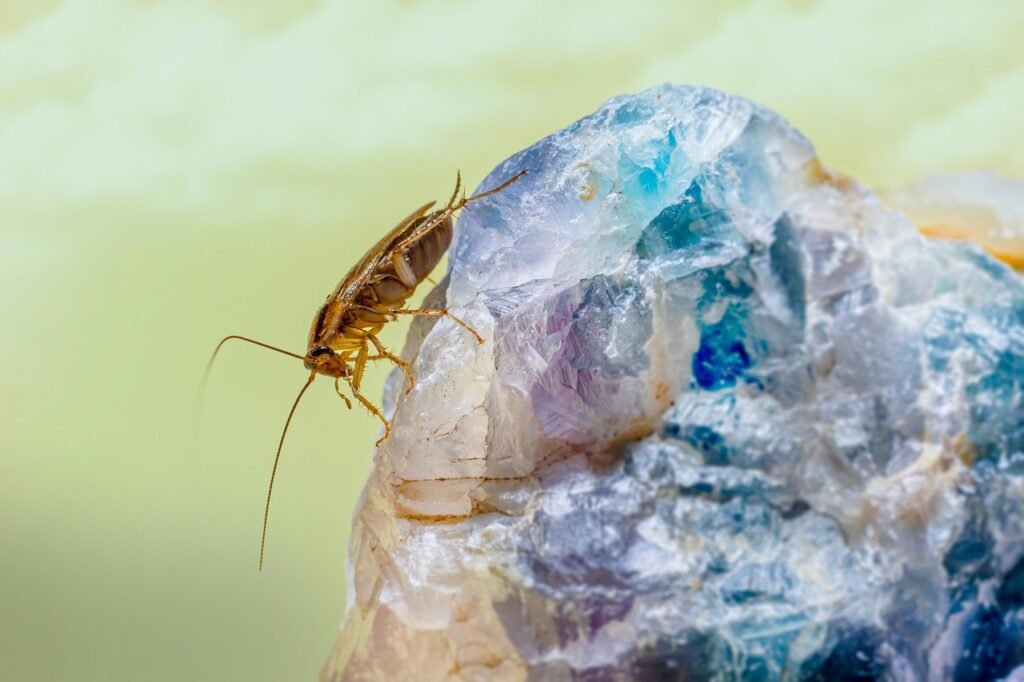
You turned on the kitchen light at 2am and saw them scatter. Small, light brown roaches darting behind the stove, under the fridge, into the gap between the counter and the wall. You killed three. But you know there are more.
That’s German cockroaches. And here’s the hard truth: if you’re seeing them at night, you’ve probably got hundreds you’re not seeing during the day.
Why Are German Cockroaches So Hard to Kill?
Not all roaches are created equal. German cockroaches (Blattella germanica) are the most common indoor roach species in Canada, and they’re uniquely difficult to eliminate for three reasons:
They reproduce faster than any other roach species. A single female carries an egg case containing 30-40 eggs. She produces a new case every 20-25 days. Those offspring reach breeding age in 36 days. Do the math: one female can be responsible for over 300,000 descendants in a single year.
They’re small enough to hide anywhere. Adult German cockroaches are only 13-16mm long. Nymphs are smaller. They squeeze into cracks the width of a credit card — behind outlet covers, inside appliance motors, between stacked dishes, under baseboards. You’ll never see most of them.
They’ve developed resistance to common pesticides. Decades of exposure to over-the-counter sprays have created German cockroach populations with genetic resistance to pyrethroids and other chemicals that used to work. What killed roaches in the 1990s often just annoys them now.
This combination makes German cockroaches the most persistent indoor pest we deal with across the GTA.
Why GTA Apartments Get Hit Hardest
If you live in an apartment building in Toronto, Brampton, or Mississauga, you’ve probably noticed: cockroach problems seem to come out of nowhere and spread fast.
That’s not random. Multi-unit buildings create perfect conditions for German cockroach infestations:
Shared walls and plumbing. Roaches travel through wall voids, pipe chases, and electrical conduits. If Unit 302 has roaches, Unit 304 probably will within a month. You can keep your apartment spotless and still get an infestation from a neighbor’s unit.
Constant warmth. German cockroaches need temperatures between 21-27°C to thrive. Older apartment buildings in Toronto maintain that range year-round. Unlike outdoor roach species that die off in winter, German cockroaches breed through January and February without slowing down.
Dense populations. More units mean more food sources, more hiding spots, more breeding sites. A 20-story building in downtown Toronto can support tens of thousands of German cockroaches across multiple infested units.
Delayed treatment. Many tenants don’t report infestations immediately — either because they’re embarrassed or they assume it’s their fault. By the time building management gets involved, the infestation has spread to adjacent units.
We see this pattern most often in high-rise buildings built before 1990. The combination of aging infrastructure, shared utilities, and high tenant turnover creates ongoing cockroach pressure that’s hard to break without building-wide treatment.
Real example: Last November, we got called to a 14-unit building on Dundas West near Trinity Bellwoods. Unit 6 had German cockroaches but the tenant hadn’t reported it for three months. By the time we inspected, six other units on the same floor had active infestations — all traveling through the shared plumbing chase behind the kitchens. The building manager spent $4,200 treating eight units when treating one unit early would’ve cost $350.
The Reproduction Problem: Why Small Infestations Explode
Here’s what actually happens: you see one or two roaches at night. Maybe you kill them. Meanwhile, there are already 20-50 more hiding inside your stove, under the sink, behind the fridge. Those females are carrying egg cases with 35 eggs each. In 28 days, those hatch. In 5 weeks, those nymphs start breeding.
Do the math forward: 50 adults produce 700 nymphs in month one. Those 700 become 350 breeding females in month two. Each produces another egg case. By month three, you’re looking at 12,000+ roaches in a two-bedroom apartment.
By the time you start seeing roaches during the day — inside your microwave, your coffee maker, your toaster — the population has hit severe overcrowding. The droppings that look like black pepper are in every drawer. That’s when most people call us. But by then, you’re 8 weeks past the point where DIY treatment would’ve worked.
Can You Get Rid of German Cockroaches Yourself?
Short answer: rarely, in apartments.
Hardware store bait traps work for the first few roaches. Then the population develops bait aversion — they literally evolve to ignore the poison within a few generations.
Sprays and foggers are worse. Over-the-counter sprays kill on contact but don’t reach roaches hiding in wall voids or inside appliances. Foggers push them deeper into hiding and spread them to adjacent units. We got called to a high-rise near Scarborough Town Centre where a tenant fogged Unit 1208 and created infestations in four neighboring units within two weeks.
Keeping everything spotless helps but won’t eliminate an established infestation. German cockroaches can survive on toothpaste residue, grease splatters you can’t see, and the glue on cardboard boxes. They need less food than you think.
The real problem: landlords who ignore the issue. Some building managers assume roaches are a tenant cleanliness problem and refuse to pay for professional treatment. One untreated unit will re-infest the entire building. We’ve seen this cost property managers 10x more when they finally treat three floors instead of one unit early.
How Do Professionals Get Rid of German Cockroaches?
Eliminating German cockroaches in apartments requires three things: reaching hidden populations, breaking the breeding cycle, and preventing re-infestation from neighboring units.
Here’s what actually works — and why you can’t do this with hardware store products:
Gel bait applications in hidden areas. Modern gel baits use slow-acting active ingredients that roaches carry back to harborage sites. One roach consumes the bait, returns to the wall void, dies, and other roaches feed on the carcass — spreading the poison through the colony. We apply these baits inside electrical outlets, under appliances, in cabinet hinges, and other high-traffic roach areas.
Insect growth regulators (IGRs). These disrupt the molting process so nymphs can’t mature into breeding adults. IGRs break the reproduction cycle — critical for stopping population growth.
Dust applications in wall voids. For severe infestations, we inject insecticidal dust into wall voids through drilled access points. The dust clings to roaches as they travel through walls and remains active for months.
Multiple treatments over 4-8 weeks. Eggs survive most treatments and hatch 3-4 weeks later. That’s why one-time treatments rarely work. We schedule follow-ups timed to the hatching cycle to eliminate new generations before they breed.
Apartment building coordination. If we treat your unit but the neighbor’s unit stays infested, you’ll have roaches again within weeks. Effective treatment often requires treating adjacent units, shared laundry rooms, and garbage chutes.
What most people don’t know: German cockroach infestations are actually worse in winter, not summer. In January and February, we see peak call volume in Toronto apartments because people seal windows and crank the heat — creating perfect 24°C breeding conditions. The roaches that would normally slow down outdoors are thriving in your walls. That’s why you’re seeing more now, not fewer.
Prevention: What Tenants Can Actually Control
You can’t control your neighbors or your building’s infrastructure. But you can make your unit less attractive to German cockroaches:
Seal gaps around pipes. The space where plumbing enters your apartment is a highway for roaches traveling between units. Seal these gaps with silicone caulk or copper mesh.
Store food in sealed containers. Roaches chew through cardboard, paper, and thin plastic bags. Use airtight containers for flour, sugar, cereal, pet food.
Fix leaks immediately. German cockroaches need water daily. A dripping faucet or leaking pipe under the sink is enough to sustain a large population.
Take garbage out nightly. Don’t leave kitchen waste overnight. Even a few crumbs in a trash bag create a food source.
Unpack groceries outside your unit. Roaches and egg cases often hitchhike in grocery bags, delivery boxes, and used furniture. Unpack items in the hallway or building lobby, inspect for roaches, and discard packaging immediately.
We traced one Brampton infestation to a used microwave from Kijiji. The tenant brought it into their apartment, plugged it in, and within three weeks had roaches in every room. The microwave’s motor housing was a breeding site — dozens of egg cases glued inside where they couldn’t see them.
What Are the Signs of a German Cockroach Infestation?
Call an exterminator if you see:
- Roaches during daytime (sign of severe overcrowding)
- Roaches in multiple rooms (population has spread)
- Small dark droppings that look like black pepper or coffee grounds
- Shed skins near baseboards or under sinks
- A musty, oily smell in cabinets or behind appliances (sign of large population)
- Egg cases (small brown capsules, 8mm long) stuck to surfaces
In Toronto and Brampton apartments, German cockroach problems rarely resolve on their own. The building density and shared infrastructure mean re-infestation is constant unless the source is eliminated.
If you’re seeing roaches weekly in your Mississauga apartments — especially in the kitchen at night — that’s not a few strays. That’s an established breeding population. The longer you wait, the harder and more expensive treatment becomes.
If you’re seeing German cockroaches in your GTA apartment — especially during the day or in multiple rooms — that’s an established infestation that won’t resolve on its own. We handle cockroach removal services in Toronto, Brampton, Mississauga, and across the GTA with same-day service.
Get a free quote or call us before the problem spreads to your neighbors.